Advertisements
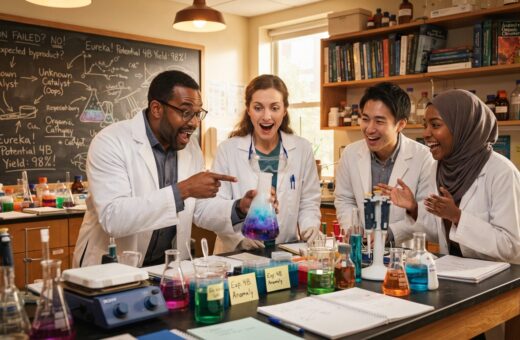
Human history It was marked by discoveries that changed daily life and knowledge. Often, a curious discovery It emerged without a plan, mixing chance and talent.
These advances were not mere news; they became cornerstones of medicine, engineering, and space exploration. Many scientific discoveries They came from laboratories, observatories, and makeshift workshops.
Exploring these milestones allows us to see how the human mind solved complex problems. Each achievement represented a leap forward in our ability to understand the cosmos and improve life on Earth.
This article recounts events that, although they seemed like fiction, were real and transformative. The reader will find examples that illustrate the union of chance and genius.
The chance behind science
Unexpected discoveries have often sparked radical changes in modern science. Chance has played a part in many brilliant minds, but it can never replace consistent effort.
Behind many innovations lies a long time of investigation and an intense jobMajor breakthroughs combine technical preparation and fortuitous moments.
- Chance allowed several discoveries to transform entire fields.
- Daily work and systematic testing create the ground for the unexpected.
- Some scientific discoveries arose when previous assumptions were broken.
- Numerous scientists acknowledge that luck was key, along with his expertise.
- Appreciating these coincidences helps to understand the complexity of scientific progress.
Understanding this balance between method and luck allows us to appreciate how the science It moves forward. Recognizing the combination of rigor and surprise also inspires new generations of researchers.
Penicillin and the curious discovery that changed medicine
What seemed like an oversight on a culture plate became a milestone in the history medical. In the summer of 1928, Alexander Fleming returned to his laboratory after a few weeks away and found mold on staphylococcus plates.
The fungus, later identified as Penicillium notatumIt released a substance that eliminated nearby bacterial colonies. This phenomenon led to the development of the first antibiotic.
The impact was enormous: in the following years, penicillin saved millions of lives and raised the hope of life global. The scientists Those from that era acknowledged that this moment represented a turning point in the science and the medicine.
- 1928: Fleming returns to the laboratory and discovers mold on his petri dishes.
- The fungus eliminates staphylococci, showing a clear antibacterial effect.
- Thanks to that discovery, millions of people They survived deadly infections.
In a single instance, a brief period of inactivity in a laboratory changed, over the years, how infections are treated. That moment demonstrates the role of chance intertwined with scientific work.
Archimedes' principle and the density of materials
An everyday gesture by a bathtub gave birth to a principle that changed the way volume is measured. Archimedes, in Syracuse during the 2nd century BC, noticed that the water The volume that overflowed was equal to the volume of the submerged body.
King Hiero II suspected his crown was not pure gold and asked Archimedes to verify it. That simple experiment allowed the calculation of the density of gold. material and thus distinguish gold from an alloy.
Every day, millions of people They use similar principles in laboratory and engineering testing. It does yearsThis discovery laid the foundations of hydrostatics.
“Eureka!” — the exclamation attributed to Archimedes in the moment of its discovery.
- Archimedes measured volume by displacement.
- The test resolved the doubt about the royal crown.
- Since then, the technique has been used in science and industry.
The accidental origin of the microwave
A mistake in a war laboratory led to an invention that transformed the domestic kitchen.
During World War II, engineer Percy Spencer was working with magnetrons for radar when he noticed a chocolate bar melting near the equipment.
Molecular vibrations in water
Spencer understood that the energy The magnetron's movement caused the molecules to move waterThese vibrations generate a great deal of heat. speed.
- Engineer Percy Spencer observed the effect while tuning magnetrons in a critical war year.
- Electromagnetic energy heats food inside a closed metallic system.
- The metal casing and safe design enabled the development of a household appliance.
- Millions of people use the microwave every day thanks to that accidental idea.
In a single moment, what was observed in the air of a workshop changed the world. Development transformed a technical curiosity into an essential device that saves time and energy.
The story behind the computer term bug
A logbook and a moth marked the shape in which the technology He talks about his mistakes.
The mathematician Grace Hopper and her equipment They were working on the Mark II computer at Harvard University when they found a moth trapped inside the system.
When they pasted the insect into the logbook, they noted "First real case of bug found."
That gesture registered, for first time, the use of “bug” to describe a software error.
- The history It tells how a physical detail gave a name to a virtual concept.
- As time passed yearsmillions of people The industry adopted the term.
- Today, the anecdote is still present in manuals, talks, and technical culture.
“First real case of a bug found.”
This brief anecdote shows how a small incident in a laboratory became a global standard and part of computer culture.
The discovery of X-rays
An unexpected flash of light in a laboratory forever changed the way we look at the human body.
In 1895, physicist Wilhelm Röntgen observed a strange glow near cathode ray tubes. This moment became legendary. history as an important discovery which showed a new light capable of penetrating tissues.
He find It allowed, for the first time, a view inside the human body. Röntgen obtained the X-ray of his wife's hand, an image that demonstrated the properties from that radiation and transformed the medicine.
- In 1895, Röntgen detected a strange brightness in his laboratory.
- The discovery showed first time the internal structure of the body.
- The X-ray of his wife's hand became a symbol of progress.
- As time passed yearsmillions of people They received more accurate diagnoses.
- Today we recognize how an experiment with cathode ray tubes changed the way diseases are treated. thank you in that light.
The graphene revolution as the thinnest material
In 2004, a nearly discarded slide at the University of Manchester triggered a discovery that changed the world of materials.
Physicists Andre Geim and Konstantin Novoselov isolated an atomic layer of graphite. This film is transparent, flexible, and highly conductive of electricity.
Graphene is considered the material thinnest known. His properties unique have revolutionized the field of materials science.
The technology Graphene-based technology promises to create more durable and efficient electronic devices. Researchers are exploring its applications in touchscreens and energy storage.
“A tiny layer showed that even laboratory waste can hide high-impact solutions.”
- 2004: Geim and Novoselov isolated graphene from discarded graphite.
- The material is transparent, flexible, and conductive.
- Global projects seek practical applications in devices.
To read more about advancements and applications, see this page dedicated to graphene and its uses.
Decoding the human genome
Mapping the DNA sequence opened a new chapter in medicine and biotechnology.
The Human Genome Project was completed in the year 2003 the 99,99% of the sequence. They were years collaborative work and an ambitious study with a budget of $280 million.
The Book of Life Project
A consortium of scientists Researchers from six countries managed to map the helix and create a global reference. That achievement changed the field genomic and transformed our reality biological.
Usefulness of junk DNA
What was previously called “junk DNA” turned out to be essential for the system of gene regulation. Subsequent studies showed that these regions control when and how genes act.
- In 2003 The map that many call the "book of life" was completed.
- He development allowed progress in the edition genetics to treat hereditary diseases.
- Millions of people They benefit today from therapies and diagnoses born from this study.
- The investigation continues: new studies They explore how molecular instructions, which contain water and other elements, define the life.
“Completing the human genome marked the beginning of an era in which genetics ceased to be just theory and began to guide real therapies.”
The detection of gravitational waves
In 2017, astronomy heard for the first time the heartbeat of spacetime after the collision of two stars.
Albert Einstein predicted these fluctuations more than 100 years ago, and time First, its existence was verified with direct signals.
In 2017, scientists LIGO and Virgo recorded waves that arrived along with light Issued by the same crash. The event occurred about 130 years —in a cosmic sense— and his record thrilled millions of people.
He development of the technology Detection opened a new field. Now, the energy released by black holes and stellar mergers, and is valued job of those who made the discovery possible.
“The universe spoke in two signs: vibration and light.”
- Nobel Prize awarded for the contribution of Weiss, Barish and Thorne.
- He system detectors continue listening every day to capture events that occurred millions or billions of years ago.
- This advance marks a new chapter in the observation of the cosmos and in the edition of astronomical models.
The mystery of the interstellar visitor
An unexpected visitor crossed our cosmic neighborhood in 2017 and raised questions about what other systems bring. In October of that year, it was confirmed... find from Oumuamua, the first asteroid to arrive from outside the system solar.
Characteristics of the Oumuamua object
The observations showed a shape The elongated shape was evident when measuring how it reflected sunlight. This variation in brightness allowed, therefore, for first time, estimate its rotation and appearance.
The investigation of his career and speed He indicated that it wasn't smart technology, but an icy rock. The data suggests that, after traveling for years because of the space, it probably preserved water under a dry bark.
- October 2017: the discovery of Oumuamua was confirmed.
- Its elongated shape was deduced from how it reflected light.
- Thanks to the analysis of trajectory and speed, it was concluded that it was an icy rock.
- I travel several years before crossing the interstellar air near Earth.
“The study of Oumuamua expanded our understanding of objects that travel through the space between stars.”
Conclusion
Science It reveals, time and again, unexpected twists that rewrite our understanding of the history.
These discoveries And moments of insight show how effort combined with luck produces breakthroughs. Many are examples of scientific discoveries which opened new avenues, from penicillin to edition genetics.
Understanding the role of water and DNA helps to assess the complexity of life that we inhabit.
Taken together, these findings transformed our world and expanded the reality of what is possible. We invite you to continue exploring these pages of the history to inspire new generations.