Advertisements
Have you ever wondered how tiny changes in a laboratory can rewrite the history of science?
On this journey, you'll see milestones that, although they seem like something out of a novel, have already transformed the real world. From the confirmation of the Higgs boson to the near-complete decoding of the human genome, these events marked a turning point.
We'll guide you through key years and the practical impact of each advance. You will understand Why have projects like CERN, the Kepler mission, or DNA studies changed how you think about matter, life, and origins?
In the end you will understand that each achievement opened new questions and that science continues to be a collective narrative that evolves year after year.
Key findings
- These findings redefined the history recent science.
- They have an impact on everything from medicine to space exploration in the contemporary world.
- Every advance comes from global projects and intense collaboration.
- Many milestones occurred in specific years that changed paradigms.
- They are starting points: they invite you to keep asking questions and learning.
The Higgs Boson: The “God particle” you took decades to see
In 2012 a decisive step was taken to understand why particles have mass.
On July 4, 2012, CERN announced the detection of a particle consistent with the Higgs boson. This was the result of research that began in the 1960s, proposed by Peter Higgs.
For decades, scientists from around the world contributed ideas and data. The Large Hadron Collider team used detectors like ATLAS and CMS to separate a very faint signal from the noise.
- You are in the 2012 announcement: evidence that completes the Standard Model after a long analysis of data.
- You see how the research accumulated since the 1960s mobilized resources and international collaboration.
- You understand that the discovery explains the mechanism that confers mass and opens up new questions in physics.
- You learn that confirming results took longer and required statistical controls and improvements in hardware and software.
This milestone It not only resolved a theoretical gap: it created new routes to explore physics beyond the Standard Model and showed how much scientific cooperation can achieve.
From the “book of life” to the laboratory: human genome, cellular reprogramming and the DNA that was not junk
From sequence to cell: this is how we went from knowing the code to rewriting the cellular identity.
2003: The human genome, 99,99% deciphered and the impetus for gene therapies
In 2003, an international consortium of scientists completed 99,991% of the sequencing of the human genome. This achievement brought together researchers from several countries and paved the way for further research. development of gene therapies and more accurate diagnostics.
Cellular reprogramming: from a skin cell to a neuron, for the first time
In 2006, experiments in mice showed that you can change the shape and the function of an adult cell. This technique, which won the Nobel Prize in 2012, showed that cell identity is not fixed.
ENCODE and “junk DNA”: the regulator your genes needed
In 2012, the ENCODE project revealed that non-coding regions regulate gene activity. That find It changed how you interpret variants and health risks.
“The combination of genomic mapping with cell reprogramming exemplifies how cooperation accelerates medicine.”
- In a few yearsDNA reading spurred clinical applications.
- The coordination between scientists and open data accelerated results.
- Today you see applications in regenerative medicine and tests with the patient's own cells.
Ardi in Ethiopia: the hominid that displaced Lucy and rewrote millions of years of history
A discovery in Ethiopia forced paleoanthropologists to reconsider millions of years of our history.
Ardipithecus ramidus, nicknamed Ardi, is a female weighing about 50 kg and measuring 120 cm. She was found in 1992 and described on October 1, 2009 by a equipment international in Science.
At 4.4 million years old, Ardi surpassed Lucy (3.2 million years old) as the oldest known fossil at the time. This finding changed the interpretation of early adaptations such as bipedalism and habitat use.
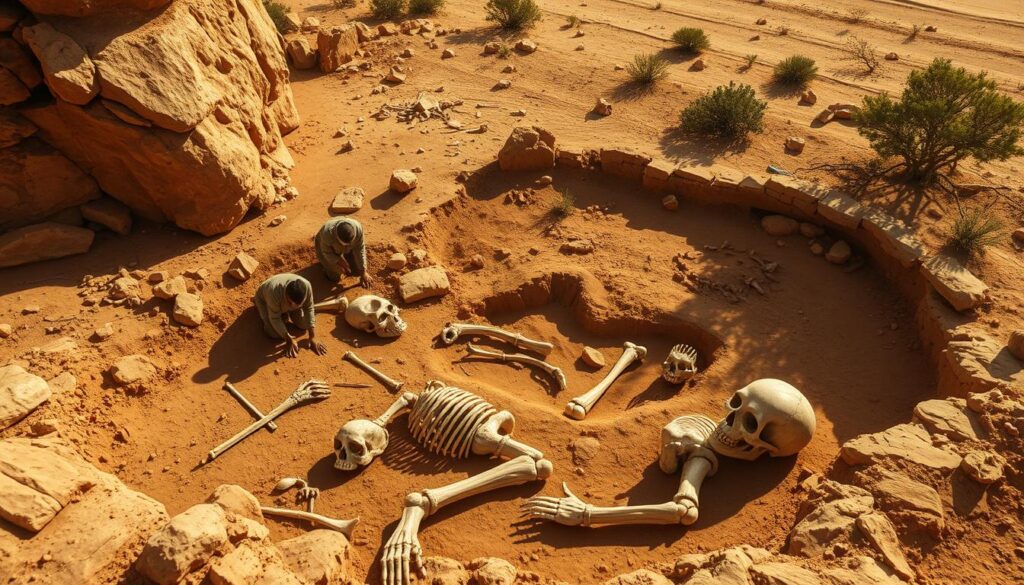
He find It showed features that allow inferences about locomotion, diet, and environment. Researchers reconstructed a fragmentary skeleton after years of excavation and analysis.
“Each new fossil is a piece that forces you to revise the story you thought was complete.”
- You are placed in a context where chronology goes back millions of years.
- You see how a equipment interdisciplinary team combined data to interpret the fossil.
- You understand that the fossil record remains a patient puzzle.
Ardipithecus ramidus: a 4.4-million-year-old female presented by an international team
Water on Mars: from hint to physical proof at the Martian North Pole
The Phoenix probe transformed suspicions into concrete evidence.
On June 19, 2008, NASA confirmed that it had water in the form of ice near the North Pole of Mars. Phoenix, launched on August 4, 2007, excavated and analyzed samples on the surface of planet.
After years From clues detected from orbit, physical material was obtained for the first time. first time He closed the circle of hypotheses about ice deposits.
- You see the direct evidence: ice extracted and detected in situ by instruments designed to excavate and analyze volatiles.
- You understand how finding water reconfigures debates about habitability and manned exploration plans.
- Do you value the role of equipment that operated in short windows, making critical decisions in real time.
- You understand that this discovery guided climate models and helped identify targets for future missions.
“The physical evidence at the Martian North Pole changed the approach to exploration and use of in-situ resources.”
Graphene: the thinnest and strongest material that changed materials science
In 2004, a humble discovery in Manchester showed that a single layer of atoms could redefine what was possible.
Andre Geim and Konstantin Novoselov isolated crystalline monolayers of graphite at the University of Manchester. They started with layers that were normally discarded and obtained a object two-dimensional: graphene.
This material is transparent, flexible, extraordinarily strong, and conductive. Its mechanical and electronic properties surpass many materials you've worked with over the years. years.
The ingenious experimental method—simple but effective—allowed laboratories of world They replicated the discovery. That accelerated the development of applications in electronics, sensors and composites.
- You understand why a single atom changes screen and battery designs.
- You value how a few scientists With accessible tools they opened a new field.
- You understand that bringing it to the industry requires scaling up processes without losing its advantages.
“Sometimes, looking at what is discarded reveals what technology can most transform.”
Proving the impossible: Poincaré's conjecture goes from hypothesis to theorem
What many considered impossible in topology ended up being proven after years of intense work.
The Poincaré conjecture was formulated in 1904 by Henri Poincaré. It remained a central challenge until Grigori Perelman presented a proof in 2002.
Perelman dedicated seven years He conducted research and applied new techniques in geometry and topology. The result transformed the way the structure of three-dimensional spaces is understood.
The author rejected prizes and recognition, preferring the integrity of the proof to fame. This attitude underscores the value of time and ethics in mathematical science.
- You are approaching a challenge that demanded unprecedented tools and theoretical collaboration.
- You see how prolonged research reconfigured techniques and opened new paths.
- You understand that an abstract result can have practical echoes decades later.
“The test not only solved a historical problem: it changed the discipline.”
Nanotechnology at an invisible scale: regenerative medicine, electronics, and beyond
Since 2001Nanotechnology began to show real-world applications in electronics, biology, and healthcare. You'll see how the development of nanoscale materials went from laboratory ideas to proposals with clinical impact.
From diagnosis to treatment: releasing cells and repairing organs with precision
Methods are being explored to deliver cells or matrices to damaged organs and promote local repair. These strategies aim to translate science into therapies that you may be able to receive in hospitals in the coming years.
- You analyze how, in just a few years, nanometric materials and devices changed sensors and targeted therapies.
- Are you familiar with proposals to release cells and matrices that help repair tissues, bringing clinical practice closer to the laboratory?
- You understand that working with such small objects requires specific techniques, toxicity control, and biocompatibility testing.
- You see why the convergence of physics, chemistry, and biology accelerates earlier diagnoses and personalized treatments.
- You consider scaling, regulatory, and cost challenges that will determine which applications reach the real world first.
On the wholeNanotechnology promises to transform how diseases are detected and cured, but its widespread adoption will depend on testing, regulations, and large-scale production.
Exoplanets and worlds with water: similar planets, habitable zones and signs of life
The search for planets outside the Solar System turned suspicions into a growing inventory of worlds.
The Kepler mission, launched on March 6, 2009, ushered in the era of discovering thousands of exoplanets. Thanks to its data, we know that many stars host objects with promising radii and orbits.
Today You refine techniques to detect similar planets and estimate their masses, radii, and distance from their star. This precision allows you to separate truly habitable candidates from false positives.
K2-18 ba 120 light-years away: methane, CO₂ and a possible DMS in its atmosphere
K2-18 b orbits a red dwarf and is located 120 light-years away. Observations revealed methane and carbon dioxide in its atmosphere.
Researchers, including Nikku Madhusudhan, have indicated a possible detection of dimethyl sulfide (DMS). If confirmed, this would be a fascinating clue, but it requires independent observations.
“The combination of spectroscopy and modeling allows us to infer atmospheric composition, but caution is key.”
- You understand how we went from suspecting to confirming planets around other stars.
- You know Kepler's role in opening the census and why you're now looking for worlds in the right zone.
- You see why K2-18 b is a natural laboratory for studying atmospheres rich in carbon molecules.
- Do you believe that the possible detection of DMS should be validated before drawing conclusions about life?
Amazing discoveries from the James Webb Telescope that seem like science fiction
The James Webb It has changed how you look at the cosmic past. Its observations in infrared light reveal objects and processes that were previously hidden.
The JWST, launched on December 25, 2021, detected disk galaxies just 3.7 billion years after the Big Bang. Authors As Christopher Conselice and Leonardo Ferreira point out, this necessitates a review of galactic formation models.
Hidden galaxies and populations
Maisie and AzTECC71 show how redshifted light reveals hidden populations. Jed McKinney comments that these galaxies only appear in deep spectra.
Black holes and early worlds
CEERS 1019 has a black hole with 9 million solar masses. Dale Kocevski suggests that "lighter" black holes may have been common in early stages.
Planetary systems and chemistry
The Webb spacecraft captured a jet stream of approximately 4,800 km from Jupiter and detected CO₂ on Europa. It also recorded water vapor in PDS 70, where rocky planets could form.
“The JWST not only delivers beautiful images: it forces us to update models and cosmic history.”
- Seeing galaxies so ordered so quickly makes you rethink assembly times and rhythms.
- Smoke-like molecules in SPT0418-47 and dense dust in SN 1987A show real processes in the early universe.
Your “first time” map: milestones that changed the way you see space and life
There are moments in space exploration that forever change how you look at our cosmic neighborhood.
First direct evidence of ice on Mars
June 19, 2008 marked the first time that ice was extracted from the ground of another planet.
Phoenix excavated at the Martian North Pole and confirmed the presence of water in the form of ice. That discovery transformed debates about habitability and resource use.
For you, that moment was the point at which the planet It ceased to be just a distant image and became a place with tangible resources.
First time you've seen CO₂ in an extraterrestrial salt ocean
The James Webb telescope detected CO₂ in a salty ocean on Europa, shining a new light on the planet. light unexpected chemical processes.
This time it raises questions about available energy and gradients that could support complex chemistry.
- Mark the first time you saw ice extracted from another planet.
- You associate CO₂ for the first time with a salty ocean outside of Earth.
- You recognize that these signals connect processes that lead millions of years and depend on thousands of technical decisions.
- You understand that, behind each milestone, there are years of work and priorities that define future missions.
“Each first time reorganizes your mental map of the solar system and guides what comes next.”
Conclusion
Each of the discoveries you saw here He condensed years of work and millions of data points to give it light to questions that humanity has always had.
During your journey, you noticed how particles, genomes, and fossils, or a piece of ice on Mars, go from being hypotheses to object of a specific study. This happens despite errors and challenges, and thanks to thousands of small improvements.
You see that planets and planet-like beings have gone from being mere suspicions to forming catalogs. Molecular biology and physics are revealing new avenues for medicine and technology.
It assumes that millions of unknowns remain, but now you have better maps, greater precision, and a community of researchers and scientists ready to make progress year after year. The next time you look at a JWST image or read a report, consider that it may be another key piece about to fall into place.
FAQ
What does it mean for a scientific discovery to “seem like science fiction”?
It refers to discoveries that transform your understanding of the world because they shatter previous expectations: from subatomic particles like the Higgs boson to exoplanets with complex atmospheres. These are advances that years ago you would have only read about in novels, but which today are backed by evidence, research teams, and reproducible data.
Why was the announcement of the Higgs boson in 2012 so important?
On July 4, 2012, CERN presented signals consistent with the Higgs boson, completing the Standard Model. This discovery explained the mechanism that gives mass to particles and opened new lines of research in particle physics and cosmology, changing the way we understand the fundamental forces.
What impact did the Human Genome Project have on medicine?
With the human genome nearly sequenced in 2003, the development of gene therapies, diagnostic tests, and cell reprogramming accelerated. Today, you can follow how that information is driving personalized treatments and techniques that convert skin cells into neurons, among other clinical applications.
Who was Ardipithecus ramidus and why is he rewriting history?
Ardipithecus ramidus is a 4.4-million-year-old hominin presented by an international team. Its anatomy suggests modes of locomotion and environmental adaptation distinct from those of Lucy, forcing us to reconsider how upright posture and life in forested habitats evolved.
Is there water on Mars, and what evidence exists?
There is growing evidence: from hints of hydrated salts to detections of solid ice at the poles and in subsurface layers. Missions like Phoenix and orbiters have provided physical data confirming the presence of water in various forms, key to understanding the planet's history and future crewed missions.
Why is graphene relevant to your daily life?
Graphene is an extremely thin and strong two-dimensional material with high electrical conductivity. Its discovery has led to applications that promise flexible displays, advanced sensors, and improvements in batteries and electronics, boosting industrial and medical developments.
What is the Poincaré conjecture and why does its proof matter?
The Poincaré conjecture was a mathematical problem concerning the topology of 3-manifolds. Its proof transformed a centuries-old hypothesis into a theorem, solidifying methods that affect geometric theory, mathematical physics, and models describing the space and shape of the universe.
How does nanotechnology help in regenerative medicine?
At the nanoscale, you can design systems that precisely deliver drugs, repair tissues, and guide cell growth. This combination of diagnosis and treatment improves clinical outcomes, reduces side effects, and opens the door to repaired or regenerated organs with less invasive procedures.
What do we know about habitable exoplanets, and which are the most promising cases?
Thanks to missions like Kepler and observatories like the James Webb, planets have been found in habitable zones where the distance from their star allows for liquid water. K2-18 b, 120 light-years away, showed signs of methane and CO₂ in its atmosphere, sparking interest in possible biological or geochemical processes.
What recent discoveries from the James Webb seem like they're straight out of a novel?
Webb has detected very early disk galaxies, organic molecules in remote systems, and water vapor in protoplanetary disks. Observations like CEERS 1019, hidden stellar populations, and extreme dust in SN 1987A force you to rethink chronologies and models of cosmic formation.
What space milestones should you know about as a “first time”?
Among the milestones are the first direct evidence of ice on Mars by Phoenix and the detection of CO₂ in salty extraterrestrial oceans. These moments mark turning points in the search for life and in the planning of missions to explore habitability beyond Earth.
How do these advances affect future generations and society?
Every discovery drives technology, education, and public policy. From new medical therapies to industries based on advanced materials, discoveries create jobs, ethical challenges, and opportunities for your generation to participate in research and space exploration.