Advertisements
Have you ever wondered what the boundary is between weird and useful? Here you will find answers that will surprise you.
The Invention Factory And reports from BBC Mundo bring together creations that combine ingenuity and service, from transparent appliances to the Ford Lane-Keeping Bed and the Samsung Firevase.
Throughout this journey you will see how a idea It can be transformed into a real product. You'll understand who created it, how it works, and where it has been tested.
We'll show you why some inventions achieve success and others not. You'll see key categories: home, well-being, and mobility, and you'll see how the technology It serves people.
By the end, you'll be able to distinguish a clever idea from a useful solution. You'll also learn the basic steps to validate and patent an idea and bring it to fruition. reality.
Key findings
- You'll discover inventions that improve your day without losing the smile.
- You will understand the process from idea to patent.
- You will see real examples documented by reliable sources.
- You will learn to assess whether a creation has practical value.
- You will find inspiration for your own solutions in the real world.
Why these curious inventions are catching your attention today
Some unusual objects capture your attention because they combine spectacle and utility. The 3-meter dynasphere that reaches 50 km/h and the Ford Lane-Keeping Bed exemplify this blend: visual impact and a clear solution to a problem.
Your first time You rarely forget an object: if the interaction is simple and memorable, it sticks. The shape of the device instantly communicates its use, and your brain processes the logic behind the design.
"What surprises and solves problems often becomes part of the routine."
It also matters moment of your life. If you're looking for rest, security, or comfort, a device that reduces friction will win you over faster. Besides, people remember what excites them and works.
- A clear and distinct experience makes all the difference.
- The form should be surprising but consistent with its function.
- Behind it all is an inventor who adapts known technologies to everyday life.
In the end, you're left wondering: why wasn't this thought of before? That combination of common sense and visual appeal is what transforms an idea into something you want to try again as a curious person.
Criteria for choosing rare but useful inventions
The best way to evaluate a device is to ask yourself what problem it solves and whether its implementation works in real life.
From problem to solution: what does the device solve?
Start with a idea clear: defines a single main problem that the device fixes directly and measurably.
Use the ask “What, How Much, Who, and How Many” to pinpoint market demand and size. This guide comes from La Fábrica de Inventos and helps confirm the product's viability.
From idea to reality: prototype, patented and used in the world
Follow practical steps: design, prototype, patent, and final release. Apply Occam's Razor: fewer mechanisms are usually more scalable.
“Simple execution tends to be the most cost-effective.”
- Connect with inventors and the sector to iterate quickly.
- Evaluate safety and standards: be responsible from the design stage.
- Define success criteria: cost, usability, and adoption.
As exampleMany ideas fail because they aren't validated in the market. By testing early, you reduce risks and bring your idea to fruition. reality.
Curious inventions for the home that change your daily life
In domestic life, small innovations change your routine more than you imagine.
Transparent appliances: see the food without opening the refrigerator
National Electronics In Japan, they sell washing machines and refrigerators with transparent doors. This allows you to see inside without opening them, reducing energy consumption. It also helps you manage the account What's missing is better planning of the purchase.
Samsung Firevase: a vase that extinguishes fires in seconds
The Firevase contains a liquid that cools quickly and blocks oxygen. It is non-toxic and non-irritating, which is why it works well in wooden houses. It is a inventor designed to act in the case critic of a domestic fire.
Butter grater and toilet with fish tank
The butter grater instantly transforms the texture for spreadability without waiting. It's a small apparatus that saves steps and time on your day.
The toilet with a fish tank offers a unique sensory experience; it can relax the headalthough it's not for everyone.
- You save steps and energy at home.
- They act quickly in critical and routine situations.
- Always consider safety and maintenance before adopting one.
Rest and well-being with unconventional ideas
To improve sleep and well-being, some devices offer unexpected approaches. Here you'll find practical inventions that aim to solve common, everyday problems.
Ford Lane-Keeping Bed
Ford adapted its lane-keeping assist system to a sliding mattress. The system realigns the person and protects your half of the bed.
This invention It uses a form inspired by assisted driving to create a fairer rest experience.
Ostrich pillow
The ostrich pillow blocks out light and noise for deep naps. It covers your head and reduces stimuli in just seconds.
Ideal when you need to recharge your energy a few times during the day.
Odor Checker
This sensor measures body odor on a scale of 0 to 10. It gives you objective feedback and suggests actions based on the level.
It is useful for the person who wants to avoid awkward moments in meetings or trips.
Hug Me Pillow
Marketed in 2009 as a body pillow, the Hug Me Pillow was presented as emotional support. For some it was comforting, for others unsettling.
The experience depends on what you're looking for: company or personal space.
- If you share a bed, Ford's system keeps your side safe.
- The ostrich pillow helps to disconnect your head and get you to rest quickly.
- Odor Checker offers objective data to avoid awkward situations.
- Hug Me Pillow provides emotional support, although it's not for everyone.
- Think about how many times a month you will need the solution before investing; this justifies the expense and maximizes success.
Mobility and energy: when technology drives you
Personal mobility is reinvented when the energy And imagination meet. Here you'll see examples that transform force and movement into new experiences.
Lunavity antigravity backpack. It integrates ten drones mounted on its head with motion sensors. When jumping, the thrusters activate to create a sensation of floating. It's a prototype designed for disability assistance and recreational use.
Fliz (2012) suspends the user in a harness between wheels. You propel yourself by running; the ergonomics of movement change completely. It has few followers, but it is a good example of the reinvention of the bicycle.
Dynasphere. Designed by John Archibald Purves in 1930, it measures 3 meters and weighs 450 kg. It has three gears and reaches 50 km/h. You control the steering by leaning your body inside the wheel; it's a unique design in the world.
Shoes with propellers. In 1962, MW Hulton tested a pair on the Grand Union Canal. Using poles and balance, the propellers allow one to "walk" on the water in calm conditions.
- We show you different ways to convert energy change the place and the context of use.
- Think about safety, autonomy, and control before trying these solutions.
- Evaluate the best moment and the surroundings (parks, canals, circuits) to take advantage of them.
Curious inventions
Certain devices blend entertainment and work in unexpected ways. Here are two examples that will make you stop and think about usage limits and etiquette.
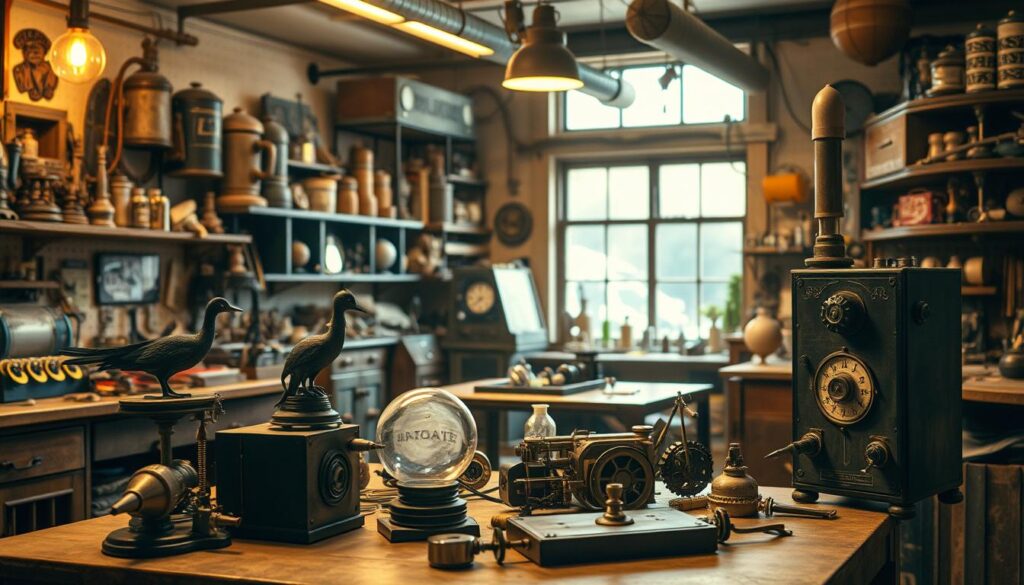
Swim Desk: a desk converted into a swimming pool
The Swim Desk transforms a cubicle into a mini pool with water With controlled temperature and adjustable current, you can swim between tasks and use the current for a short workout without leaving the office.
It's a case extreme productivity and well-being designed for modular spaces that accept rapid changes.
Smoking as a couple: double mouthpiece for sharing a cigarette
The "double" mouthpiece (photo from 1955 with Frances Richards and Earl Jones) connects two people to the same pipe using a plastic piece. It is more valuable for its shape and visual effect due to its daily usefulness.
It's a apparatus which invites discussion about social rituals and norms in the workplace.
- If you like the unexpectedThe Swim Desk allows you to train without leaving the office.
- These securities and designs broke the mold in the year from its conception and changed how people perceive the job label.
- In many cases, spectacular products create niches even if the product does not scale massively.
Historical oddities that actually existed
Solutions that seem like something out of a novel were patented in the past, but they actually existed. These pieces show how a inventor addressed a problem in his moment and in a place concrete of the world.
Impulsory: locomotive powered by horses on a conveyor belt
In 1850, Clemente Masserano presented the Impulsoria. It was tested in London and exhibited at the Great Exhibition.
He inventor It used horses walking on a treadmill to generate movement. It was slower than steam power, but it aimed to reduce costs.
Group shaving machine: twelve beards, one movement
D Merry and Son, of Birmingham, sold a machine that shaved several faces at once for seven guineas.
He apparatus It saved labor, but it didn't adapt to different faces. It was a lesson in ergonomics and facial diversity.
Snowstorm face shield: weatherproof plastic
A photograph of a plastic face shield, taken in Montreal in 1939, surfaced. The image is preserved in Dutch archives.
Its striking design didn't help its adoption. It solved a real climate problem, but usability limited its widespread use.
- Each invention It has its edition and its audience; some shine once and then remain as an anecdote.
- Impulsoria was born in key years for the industry; it prioritized cost over speed, a clear trade-off.
- These projects teach that the first time is rarely the final one: ergonomics and iteration matter.
When the idea borders on the absurd… and yet it still sells
Some ideas border on the absurd and yet still find their audience. They show that the market sometimes rewards the anecdote more than actual usefulness.
Baby Mop: a baby onesie that cleans the floor
The Baby Mop (2012) was sold on Amazon and BetterThanPants.com for approximately US$1,440. Its name and design appeal to humor and curious parents.
An executive He joked that sales are reaching "double digits." That leaves the account Clara: more fame than actual volume.
Mouse trap gun: a dangerous solution at home
James A. Williams's trap gun (1882) used a .50 caliber revolver. It failed because it obviously increased domestic risk.
“The end does not justify the means when you put safety at risk.”
Dimple creator and scalp massager: beauty and promises
Isabella Gilbert, creator of the dimple massager (1936), was sued by the AMA in 1947 for ineffectiveness and potential risks. Her 1940 massager promised 480 vibrating "fingers"; the benefits were questionable.
In beauty, the securities Eye-catching promises are often disappointing, but without evidence they tend to be deceptive.
- Some ideas generate conversation and occasional sales; that doesn't make them good solutions.
- Observe how they communicate: they exaggerate benefits and minimize risks to attract the cluster.
- Use these examples as a filter: are they selling you a laugh or a real solution? That's the key to the real thing. success.
How these inventions come about: from the “eureka!” moment to the final version
The path from the spark of a idea Even a product in your hands is usually more practical than magical.
Think about the what, how much, who, and how many to validate your idea
It starts by answering four asks: What problem are you solving? How much does it matter? Who suffers from it? How many people have it?
With those answers you define the demand and save time on unnecessary prototypes.
Prototyping, manufacturing, and licensing: paths to success
The Invention Factory It advises designing, prototyping, patenting and selling; or licensing while maintaining ownership in exchange for royalties.
Define a edition minimum viable and acts responsible: safety tests, documentation and regulatory compliance before climbing.
- Prepare a prototype or solid renders to negotiate with companies.
- Negotiate and formalize exclusivity, territory, royalties, milestones and clauses for embargo.
- Iterate with feedback from the industry; simplification is often the best route (Occam's Razor).
“An effective inventor asks questions, measures, and simplifies until the final version is achieved.”
Current trends in curious technology
Today you'll see how amazing technology is becoming practical in your home. Recent examples—transparent appliance doors and the Firevase—show that aesthetics and safety can coexist.
Functional design with a surprising touch in your home
The trend prioritizes the solution before embellishment. You'll see more products with clean lines that solve a clear problem and then add a striking detail.
This avoids the "gadget for gadget's sake" mentality and facilitates adoption in real-world spaces. The result: objects that fit perfectly in your home without requiring renovations.
Responsible solutions that prioritize safety and experience
Safety is paramount: certified materials, rigorous testing, and easy-to-follow manuals. Brands are launching modular prototypes so you can adapt the product to your space and style.
“User experience defines success: if it’s easy and safe, you use it every day.”
Today, companies are looking for a good name and a story, but what matters is that the proposal is responsible and provide real value. This is how more curious inventions with practical meaning emerge.
Conclusion
The difference between a headline and a real solution is noticeable in daily use.
You gain a practical perspective: examples like the Firevase or the Baby Mop show extremes. Others, like the Impulsoria and the Dinasfera, teach historical lessons about design and risk.
Think Like an inventor: validate with "What, How Much, Who, and How Many," prototype, patent, or license when appropriate. This reduces self-embargo to stay with the idea.
In home and well-being, take care of head and security; in mobility and water Consider the context and risks. If you're a parent, filter what benefits from what only seeks to benefit. securities.
If you want to delve deeper into how ideas changed the world and apply those steps, visit ideas that changed the worldDecide today which solutions to adopt and what idea Develop tomorrow with focus and judgment.
FAQ
What kind of inventions appear in “Strange inventions that actually exist”?
You'll find a mix of real and unique devices, from household appliances to mobility prototypes and wellness solutions. The content focuses on devices that solved a specific problem, were actually produced, or had a historical impact.
Why do these inventions catch your attention today?
They attract attention because they combine creativity and function. Many were designed to save time, improve safety, or solve everyday problems. Furthermore, some stand out for their cultural value or for the curiosity they generate by blending utility with unexpected design.
How are strange but useful inventions chosen?
Clear criteria are applied: what problem they solve, whether the prototype was manufactured or patented, its practical viability, and public reception. The impact on daily life and product safety are also assessed.
What questions should you ask yourself “From problem to solution”?
Ask yourself who has the problem, how often it occurs, whether better solutions exist, and how much it would cost to implement your idea. This helps determine if it's worth prototyping and seeking patents or industry partners.
How does an idea become reality: prototype and patent?
The process typically includes prototype design, usability testing, securing intellectual property protection, and networking with manufacturers or funding platforms. Some ideas eventually reach the market through incubators or licensing agreements with established brands.
Do transparent refrigerator appliances really work?
Yes, they work: they allow you to see food without opening the door, saving energy and time. Brands like Samsung have explored solutions with transparent screens and modules that offer this advantage in modern refrigeration.
Does the Samsung Firevase really extinguish fires in seconds?
The concept of a vase that detects fire and releases water or extinguishing agent exists in prototypes. Its effectiveness depends on the design and safety certification; always verify testing and certifications before relying on such a device.
Is a butter grater practical for everyday use?
Yes. It allows you to spread cold butter without waiting for it to soften, making kitchen tasks easier and reducing waste. It's an example of how a simple need inspires effective solutions.
Is a toilet with a fish tank safe as a "relaxing" experience?
It's more of a conceptual and aesthetic piece. Its safety and cleanliness depend on its design and maintenance. If you're interested, look for options with antimicrobial materials and appropriate filtration systems.
How do inventions like the Ford Lane-Keeping Bed help with rest?
Designs that separate areas of the bed or adjust positions aim to improve sleep and safety for couples with different movement patterns. Evaluate reviews and studies from the manufacturer on sleep quality.
What is an “ostrich pillow” and what is it used for?
It's a pillow designed for sensory isolation: it covers part of the head and reduces external stimuli to facilitate relaxation or a nap. It works well if you're looking to disconnect in noisy environments.
Does the Odor Checker accurately measure personal odors?
Odor sensors have advanced, but their accuracy varies depending on calibration and context. They serve as a guide, not a medical diagnosis. Check the specifications and the manufacturer before basing health decisions on them.
What does the “Hug Me Pillow” offer compared to missing a hug?
It's a pillow that simulates the feeling of a hug through ergonomic shapes and gentle warmth. It can improve emotional comfort and reduce occasional stress, although it doesn't replace real human interaction.
Do backpacks or devices that promise "antigravity" actually work?
Many "antigravity" concepts are marketing hype; some assistive devices use propulsion or mechanical systems to facilitate jumping or movement. Check the specific technology and certifications before buying.
What is Fliz and why is it compared to the Laufrad?
Fliz is a pedal-free bicycle inspired by historical designs like the Laufrad. It promotes balance and urban mobility through body propulsion instead of pedaling, making it ideal for short journeys.
Is the Dinasfera safe to drive inside a giant wheel?
The Dinasfera is an experimental concept that prioritizes safety through its enclosed design and bearings. Its public use depends on testing, regulatory compliance, and adaptations for real-world driving.
Are there shoes that allow you to "walk" on water for real?
There are prototypes with propellers or flotation surfaces that facilitate movement across water at low speeds. They function under specific conditions and require practice and adherence to water safety measures.
What is the Swim Desk and who is it for?
It's a work table that includes a small pool for water exercise or relaxation while you work. It's often of interest to those looking to incorporate light physical activity into their daily routine.
Is smoking with a double mouthpiece safe or advisable?
Sharing mouthpieces increases the risk of disease transmission. It is not a recommended practice for health reasons. If you choose to use shared devices, sanitize them properly.
What were inventions like the Impulsoria or the group shaving machine?
These were curious historical solutions: the Impulsoria used animal traction on a conveyor belt to move carts, and the group shaving machine sought efficiency in salons. They are examples of how innovation responds to the social needs of its time.
Are products like the Baby Mop safe and useful?
The Baby Mop was more of a marketing ploy than a practical product; its use raises hygiene and safety concerns. Always prioritize baby products with certification and pediatric recommendations.
How to validate your idea before investing in manufacturing?
Conduct market research, create simple prototypes, run user tests, and calculate production costs. Consider patenting the idea and seeking legal advice or joining an accelerator to scale with less risk.
What trends do you see in functional design with a surprising touch?
The trend combines ergonomics, sustainability, and emotional experiences. Brands like Philips, Bosch, and IKEA are adopting solutions that surprise without sacrificing utility or safety.
How do you ensure that a curious solution prioritizes safety and experience?
Through testing, certifications, appropriate materials, and feedback from real users, responsible manufacturers publish safety data and warranties so you can trust the product.